

5 For Friday
NYC home interior YouTube worm holes, female surrealist painters, and a new-to-me designer who designs not-your-average skirts.

Let’s skip any preamble and get right into creative finds for the week that I think are worth sharing, shall we? Ok, let’s!
Something to watch: I was on YouTube watching something else that I honestly can’t remember at this point, but the algo correctly directed my attention to a recommended adjacent video of “The Enviable Loft Fran Lebowitz Has Never Liked” from NYMag’s interior home video series, Interior Lives, from a handful of years ago (not sure if these are still a thing?). The video was accurately worth my attention because 1) I enjoy hearing Fran go off and comment on anything, and 2) I love home interiors. As a current loft renter, and not an owner, I love seeing how others find ways to fill so much wall space and deal with so much light. Inevitably, I then was served another video in this series that was equally delightful: “Amy Sedaris Reveals Her Magical Greenwich Village Apartment”, which is just about as quirky and emblematic of Amy’s personality as you would hope it to be. They’re short videos and give immense delight, so dive in and enjoy.


Someone to follow and keep your eye on: Kika Pauen was introduced to me by way of Blackbird Spyplane (if you read the previous post, you’ll start to see a reoccurring theme here), and I was immediately smitten with these skirts many made from 100% mulberry silk with elastic waistbands. They seem fun and offbeat, and not your average skirt you see swishing around. So question is: did I or did I not buy one? Feel free to guess below in the comments.
Something I did indeed buy from IDEA, a rad London vintage art bookshop, was an early pristine edition of John Lennon A Family Album, a collection of photographs from Nishi F. Saimaru, the former family assistant and who followed them around on their family vacations from the late ‘70s. The edition is in Japanese and from 1982 (two years after Lennon’s death), and it’s such a sweet collection of normal family photos you would find from any family holidaying (minus the ones on a private jet). To know me is to know I love John Lennon, and I consider this a worthy vintage art book investment I’ll have for a lifetime.
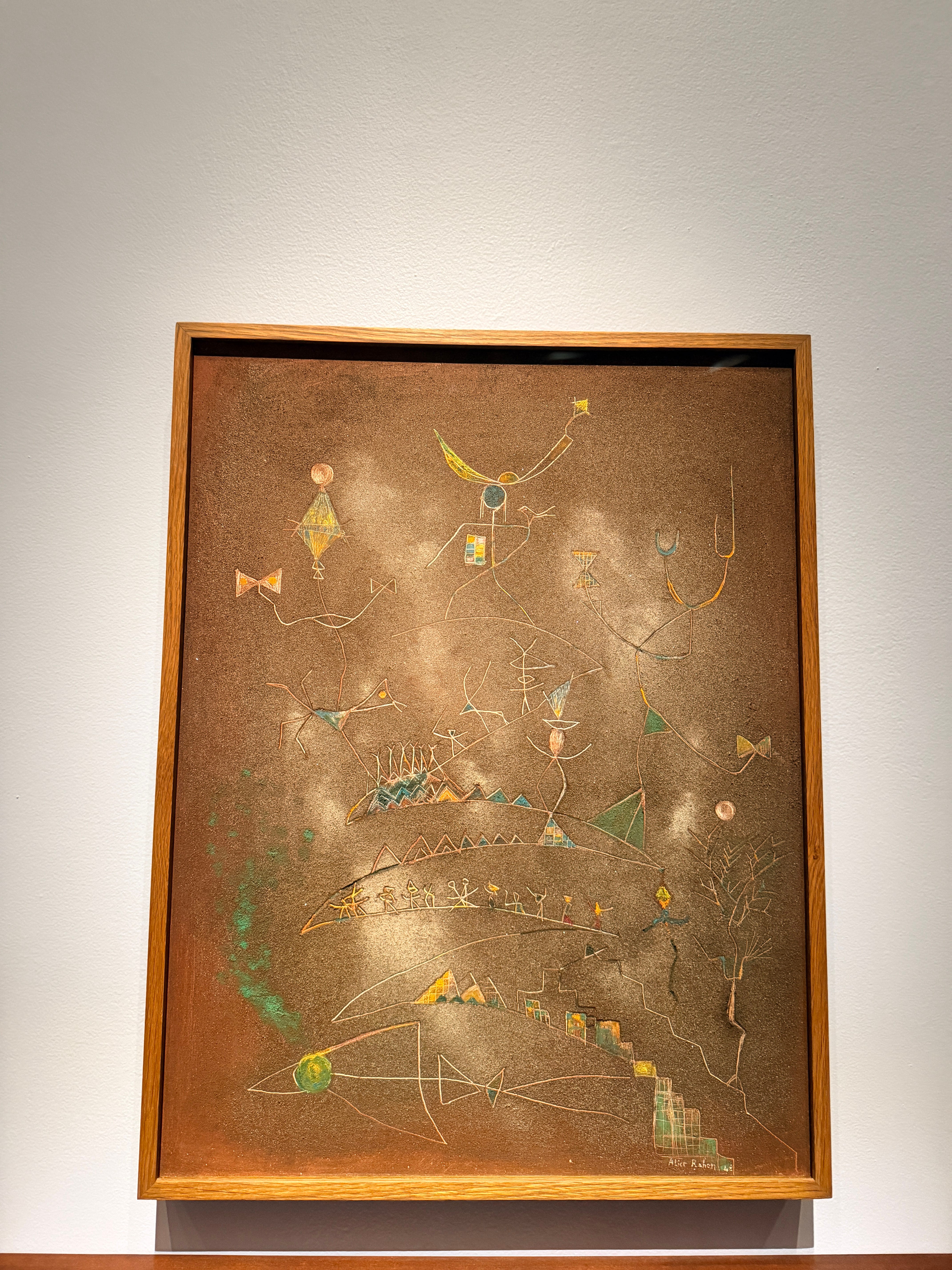
The Valley of Mexico (1946) by Alice Rahon on display at The Philadelphia Art Museum, while the Dreamworld exhibit lasts.
Some female surrealist artists to school yourself on: I visited Dreamworld: Surrealism at 100 at The Philadelphia Art Museum just before it concluded its run, which was its last stop on a global-wide tour, and while I’m forever a fan of the surrealists like Man Ray, Max Ernst, Dali, and Joan Miro, it was with such delight to learn about some of the female surrealist artists, too. Suzanne van Damme, a Belgian artist who was new to me, as well as Alice Rahon, the latter who was a poet as well as a painter who found her way to Mexico and made the country’s landscape a reoccurring motif in her artwork. She often used to mix actual sand (amazing!) into her pigments which gives off this sparkle and stoniness and evokes cave art (which she was also heavily inspired by after a visit to the Altamira cave paintings). I’ve started to deep dive on her as a figure, and she seems fascinating. I look forward to seeing more of her work wherever it might creep up and to trying to get my hands on some more literature and films about her—I’ve taken note of some to readily add to my list for reading and viewing.
Some new terminology to learn: I’m very much, heavily into the craft of book binding. I haven’t tried it myself yet, but I find the art of book making to be one of the highest crafts in calling. So I’m always keen on the details of the spine, the paper, etc. I read this specific term, Bodonian binding, the other day, and found two definitions related to it: 1) Particular binding technique where the spine of a thread-stitch bound book is made of canvas (instead of a cardboard spine), in order to make the book easier to open. 2) A variant of the hardback binding in which plates are made rigid cardboard, can or not be coated, while back is flexible, and covered with paper cloth remain exposed. No surprise the technique seems to be named after a man, and an Italian printer and typographer Bodoni (the typeface Bodoni is of the same man). Upon further research, there’s a museum in Parma, his home town, that seems like the perfect Parma activity of interest should I find myself in the nearby vicinity.
These are such great insights and tidbits. I learn so much from your findings and looking forward to diving into some of the links !
Well, I'm thinking you bought both skirts for their different vibe. Trip to Parma on our next Italy adventure.